
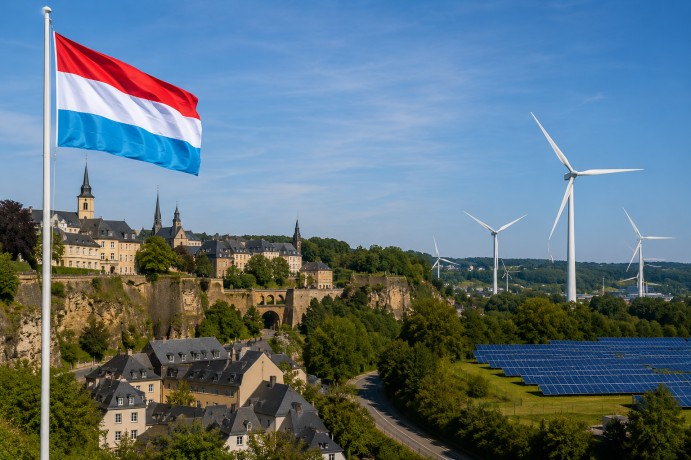
In 2025, Luxembourg found itself among the European Union’s least performers regarding renewable electricity consumption, based on the latest data from Eurostat. Despite a general rise in renewable energy use throughout the EU, Luxembourg reported that renewable sources made up only 20.2% of its gross final energy consumption. Specifically, just 23.3% of its electricity consumption was derived from renewables, placing it slightly ahead of only Czechia and Malta.
The European Union as a whole saw a significant increase in renewable energy usage over the years, with renewables representing 26.2% of gross final energy consumption in 2025, a considerable leap from 9.6% back in 2004. The EU has set an ambitious target to further boost this share to 42.5% by 2030, reflecting the bloc’s commitment to sustainable energy solutions.
Leading the way in the EU’s renewable energy landscape, Sweden reported that a remarkable 65.4% of its total energy consumption came from renewable sources. This was followed closely by Finland and Denmark, which also showcased strong performances in integrating renewable energy into their national grids.
Austria emerged as the frontrunner in the EU for renewable electricity consumption, with more than 90% of its electricity generated from renewable sources. This achievement highlights Austria’s dedication to renewable energy, setting a benchmark for other EU countries to aspire to as the bloc collectively pushes toward its future energy goals.